app.aarogyaemr.com/login
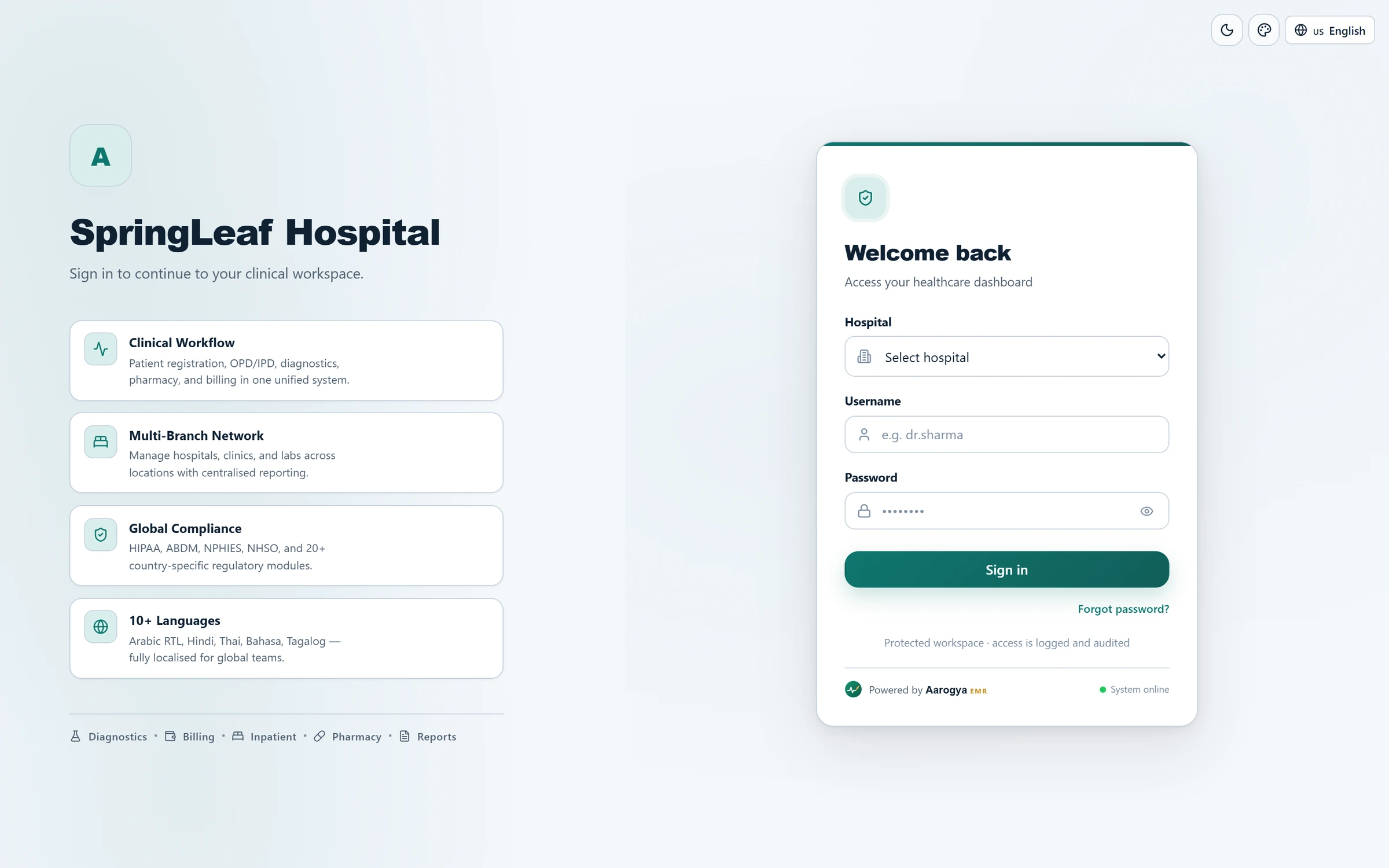
Every session starts hospital-scoped and audited — access to a hospital's data is tied to that hospital from the first screen, not bolted on afterward.
Aarogya EMR is engineered with security controls built into the platform from the ground up — not added later to pass an audit. Here is exactly what protects your patients' data today.
Every session starts hospital-scoped and audited — access to a hospital's data is tied to that hospital from the first screen, not bolted on afterward.
Patient data and backup files are encrypted at rest, so a stolen disk or backup file alone is not enough to expose records.
Traffic between the browser, application and database is encrypted end to end.
MFA is available on user logins as an additional layer beyond passwords.
Repeated failed login attempts trigger account lockout to blunt brute-force and credential-stuffing attempts.
Enterprise RBAC scopes every user — clinical or administrative — to only the modules and data their role requires.
Every clinical and administrative action is logged, giving compliance and quality teams a complete, reviewable trail.
Backup files are encrypted at rest, part of a dedicated hardening pass across authentication and disaster-recovery paths.
Digital consent capture and document management keep sensitive records governed, not floating in shared drives.
Aarogya EMR's architecture — encryption, access control, audit logging and consent management — is designed to support the safeguards expected under India's Digital Personal Data Protection Act, 2023 and common hospital accreditation frameworks such as NABH. Formal certifications and third-party audit reports are listed below once completed.
Security isn't a feature we added. It's the foundation the rest of the platform is built on.
Access to patient data in Aarogya EMR is governed at every layer — not just at the login screen.
Nurses, physicians, pharmacists, billing staff and administrators each see the modules and fields relevant to their role — enforced centrally, not per screen.
Every create, update and access event across clinical and administrative modules is captured in the enterprise audit log.
Procedures and treatments are tied to a digitally captured informed consent record, not a paper form in a separate filing cabinet.